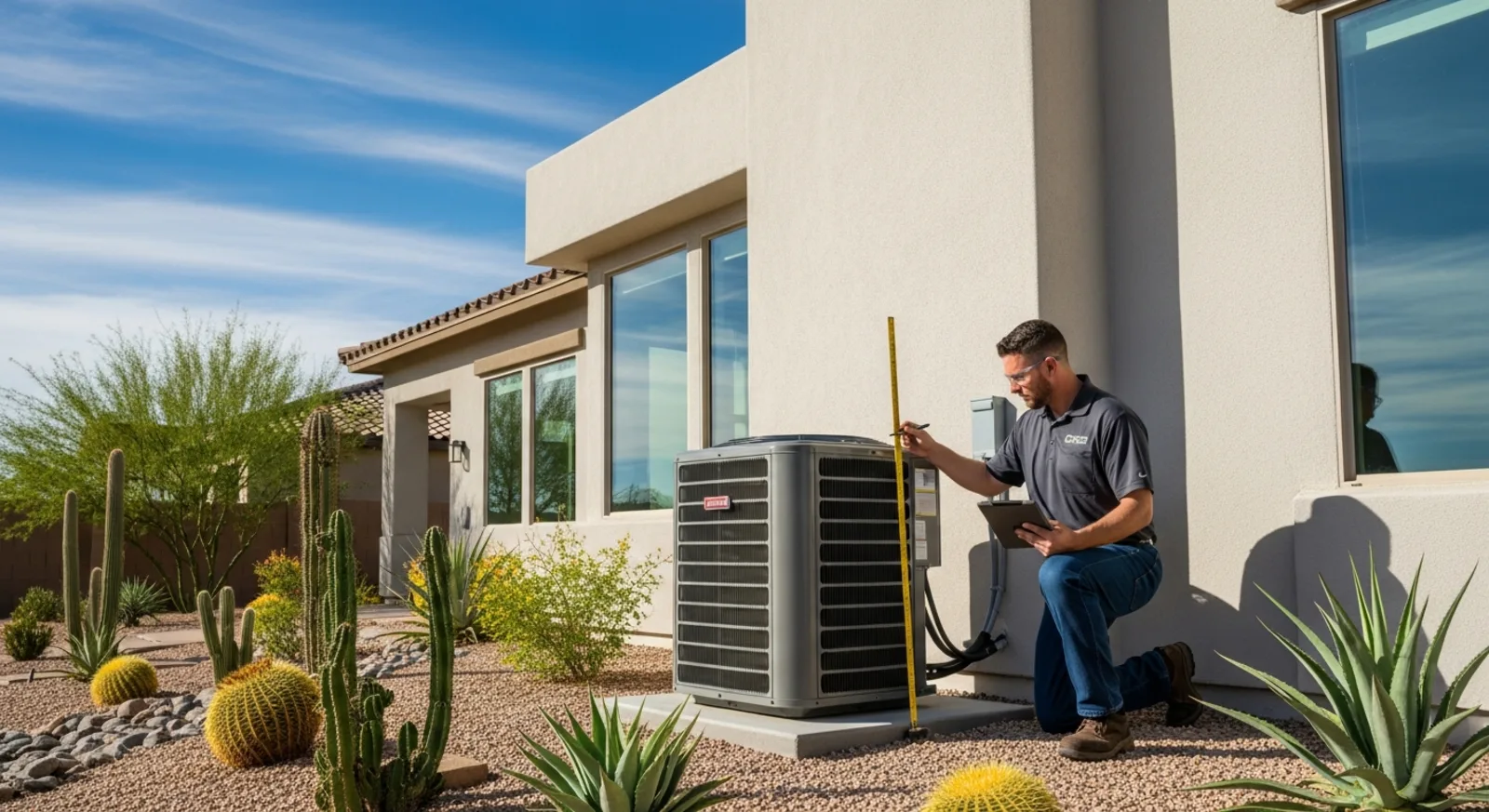
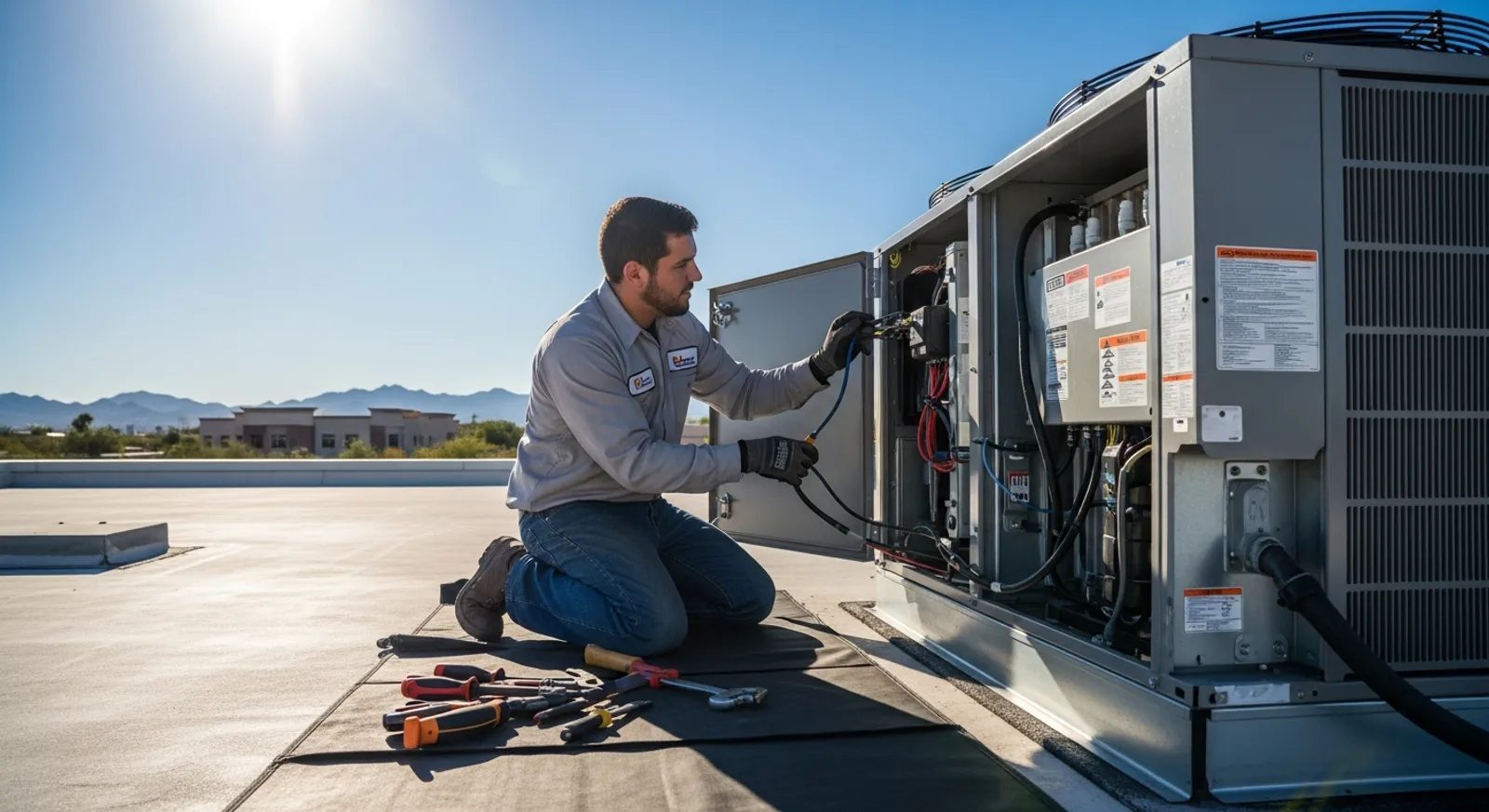
If you live in Mesa, Tempe, Chandler, or anywhere else in the East Valley, your air conditioner does more work in one summer than most systems do in two years anywhere else in the country. By July it has already run for thousands of hours against 110 degree afternoons. So the question is not whether your AC will eventually need replacing. The question is when, and how to make that decision without getting oversold.
Below are the seven signs we tell our own neighbors to watch for, followed by the most common reason a replacement quote is premature.
Why Arizona is harder on AC systems than anywhere else
The national average lifespan for a residential AC is 15 to 20 years. In the Phoenix metro, plan on 10 to 15. The combination of long run hours, dust, and sun exposure on rooftop and ground units accelerates wear on compressors, fan motors, and coils. A unit that would still be cruising in Ohio is often near the end of its useful life here.
Sign 1: Your system is more than 10 years old
Age alone is not a verdict, but it is the single strongest signal. After year 10 in Arizona, parts begin to fail in clusters and the efficiency you bought new is long gone. A system from 2014 or earlier is probably operating at 70 to 80 percent of its original SEER rating, which shows up directly on your APS or SRP bill.
Sign 2: It still uses R-22 refrigerant
R-22 (the old "Freon") was phased out by the EPA in 2020. It is no longer manufactured or imported. Recharging an R-22 system today costs roughly four to six times what it did a decade ago, and prices will only keep climbing. If a technician tells you your system needs an R-22 recharge, that is a strong signal to price out replacement instead of pouring money into refrigerant that is going extinct.
Sign 3: A single repair costs more than 50 percent of replacement
The simple rule we use with our own customers is this: multiply the proposed repair cost by the age of the unit in years. If that number is greater than the cost of a new system, replacement is the better long-term math. For typical part-by-part prices in our area, see our 2026 AC repair cost guide for Mesa.
Quick example
A 12-year-old system needs a $1,400 compressor repair. 12 x $1,400 = $16,800. If a new properly sized system installs for $9,000 to $12,000, replacement wins on math, energy savings, and warranty.
Sign 4: Your electric bill keeps climbing for the same usage
Pull up your APS or SRP usage history and compare this June to last June. If your kilowatt-hours are similar but your bill is meaningfully higher, your system is losing efficiency. A 15 SEER unit from 2010 running today is closer to a real-world 11 or 12 SEER. A modern 16 to 18 SEER replacement can cut cooling costs 20 to 35 percent.
Sign 5: Some rooms never get cool
Uneven cooling is sometimes a duct or insulation problem, but on older systems it usually means the compressor and blower can no longer move enough conditioned air to overcome heat load. If your west-facing bedrooms run 6 degrees warmer than your thermostat in the afternoon, the system is undersized for what it has become.
Sign 6: It short cycles (turns on and off constantly)
A healthy AC runs in long, steady cycles. Short cycling, where the system kicks on for two minutes then shuts off, then repeats, is usually a failing compressor, a refrigerant leak, or a bad control board. Each one of those is a major repair on an older unit.
Sign 7: Humidity hangs in the house, especially during monsoon
A working AC pulls humidity out as a side effect of cooling. If your home feels sticky in July and August even with the thermostat at 76, the system is no longer doing the dehumidification job it should. That is a comfort issue and an indoor-air-quality issue.
Free, no-pressure assessment
Not sure if it is time? We will tell you the truth.
We offer free in-home replacement estimates and we will tell you honestly when a repair is the smarter call. No commission, no high-pressure sales.
When you probably do not need to replace yet
Plenty of replacement quotes in this valley are written when a repair would have done the job. These are the situations where we tell homeowners to repair, not replace:
- The system is under 8 years old and still on its original refrigerant
- The failure is a single isolated part such as a capacitor, contactor, or fan motor
- Total repair cost is under 30 percent of replacement
- The system was sized correctly when installed and is still keeping up on the hottest days
If a contractor jumps straight to a replacement quote without working through this list with you, get a second opinion. We are happy to provide one.
What to expect from an honest replacement quote
A trustworthy estimate in Mesa should include all of the following in writing:
- A real Manual J load calculation, not just "what you have now"
- The model number, SEER2 rating, and tonnage of the proposed system
- Line-item cost for equipment, labor, permits, and disposal
- Manufacturer and labor warranty terms in plain English
- Financing options if you want them, with no pressure to use them
If something on that list is missing, ask for it. Any reputable installer will provide it the same day.
A new high-efficiency system may also qualify for utility rebates and a federal tax credit, which can take a real bite out of the price. Before you buy, read our guide to Arizona AC rebates and tax credits for 2026.
Bottom line
If your system is over 10 years old and showing two or more of the signs above, it is time to start pricing replacement. If it is younger than that and the failure is a single part, repair is almost always the smarter move. The best contractor is the one willing to tell you which situation you are in.
We have been doing this in the East Valley for 25 years. If you want a straight answer from a local team that has nothing to gain by overselling you, we are a phone call away.